What Is Ongoing SEO? The Definitive Guide to Long-Term Search Success
Understanding what is ongoing SEO is the difference between a website that thrives and one that fades. It’s the consistent maintenance—like content refreshes and technical monitoring—that protects your rankings, adapts to algorithm changes, and keeps you ahead of competitors in the long-term digital race.
Launching a website isn’t the finish line; for Google, it’s the starting gun.
Ongoing SEO is the consistent maintenance that keeps your website performing, much like the oil changes that keep a car from breaking down. It is not a one-time setup. If you want to stop losing traffic to competitors who are simply more consistent, you need to understand the daily work required.
Is SEO a one-time thing? No. A one-time setup can get a site indexed, but rankings fade as competitors publish and Google changes its rules. Ongoing SEO maintenance is the monthly work of refreshing content, fixing technical problems and earning new links so you keep what you have built. If you only need the site to exist, a one-time setup may be enough; if you need it to bring in customers, it is not. See what our SEO services include.
Key Takeaways:
- Refresh old content. Google dislikes stale information, so you must update stats, dates, and examples to maintain your position on page one.
- Fix technical debt. Links break, images become too large, and code gets messy over time, even without direct changes.
- Compete constantly. Your competitors are analyzing your top keywords and creating better content to take your spot.
- Build authority continuously. You need to earn new backlinks over time to show search engines that your content remains trustworthy.
- Adapt to algorithm updates. The rules of search shift constantly, and a strategy from a few years ago is no longer effective.
The “Set It and Forget It” Myth
Why People Think SEO is a One-Time Thing
Many business owners treat their website like a printed brochure. Once it’s done, it’s done forever. This mindset is reinforced by agencies selling “SEO Audits” or one-time packages that suggest a simple tune-up is all you need. You pay a fee, get a report with green checkmarks, and assume you have crossed the finish line.
That feeling of completion is an illusion. Google made over 4,000 changes to its search algorithm last year alone, about 11 changes every day. This means the “perfect” site from January is likely lagging by March. If you view SEO as a pre-launch checklist, you are not competing; you are standing at the starting line while everyone else runs the marathon.
Changing Perspectives: SEO is a Living Thing
Your website is a living part of a digital ecosystem that never stops changing. If you stop publishing fresh content or updating old pages, Google’s crawlers visit less frequently. They decide your business has gone dormant and is not worth showing to users who want current information.
Then there are your competitors. While you celebrate reaching page one for a keyword, three other businesses are targeting that same term with fresher content and more recent backlinks. Your search strategy must be a conversation with the market that evolves weekly, not a monologue you delivered once.
This goes beyond content. User behavior changes constantly. A few years ago, few people focused on “near me” voice searches, but now it is a huge source of local traffic. You must pivot based on the data in Search Console. Otherwise, you are building for a version of the internet that no longer exists.
My Take on Ongoing SEO: It’s More Interesting
Many see continuous work as a chore, but I enjoy the strategic nature of it. It is like a game where the rules are always changing. You can run experiments, like changing a title tag or rewriting an introduction, and watch the results in your analytics. This is more satisfying than checking boxes on a static list.
You shift from being a victim of the algorithm to a detective. When traffic dips, it is not a disaster; it is a clue. You get to figure out what changed and why.
Accepting that SEO is an ongoing process also removes the pressure of a perfect launch. You know you will iterate and improve the page next month. This gives you the freedom to try different content angles or target new long-tail keywords, knowing every small win builds on the last.
The “Gym Membership” Analogy: Why It Makes Sense
Getting Fit vs. Getting Found
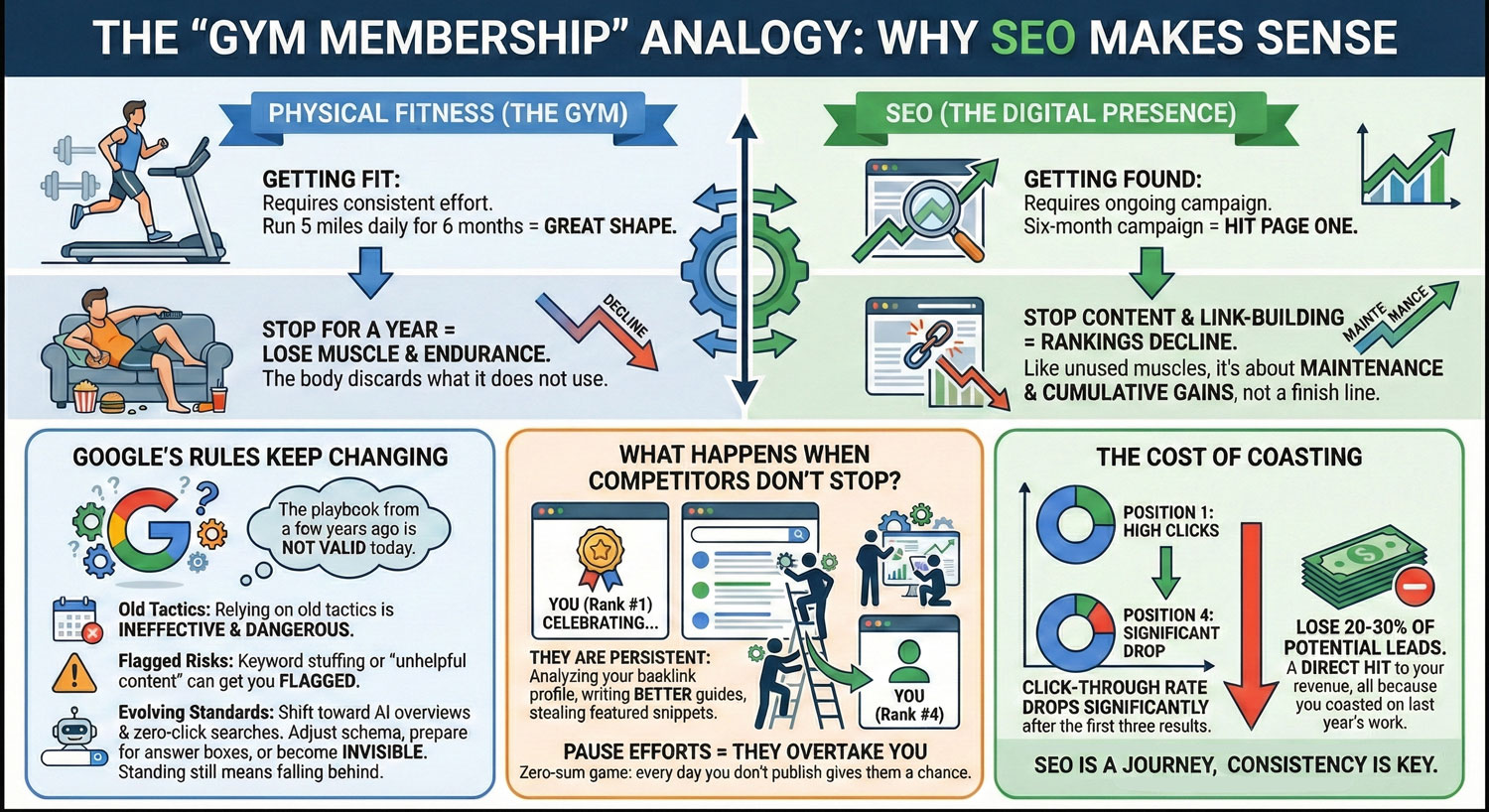
Business owners often treat SEO like a one-time surgery, but search engines do not operate that way. Think about physical fitness. If you run five miles daily for six months, you will get in great shape. If you stop for a year, you will lose that muscle and endurance. The body discards what it does not use.
SEO works the same way. You might hit page one for a target keyword after a six-month campaign. But if you stop your content and link-building efforts, your rankings will decline like unused muscles. It is about maintenance and cumulative gains, not a finish line.
Google’s Rules Keep Changing
The playbook from a few years ago is not valid today. Google makes thousands of changes every year, from small tweaks to major core updates that can erase 40% of a site’s traffic overnight. Relying on old tactics is ineffective and dangerous for your site’s health.
What worked to rank a local service page three years ago might get you flagged for keyword stuffing or “unhelpful content” today. The definition of quality evolves constantly.
Consider the current shift toward AI overviews and zero-click searches. If you are not constantly adjusting your schema markup or preparing for answer boxes, you become invisible even if your rankings have not technically dropped. Standing still means falling behind because the standard for relevance gets higher daily.
What Happens When Competitors Don’t Stop?
Reaching the top spot does not mean you own it forever. Search results are a zero-sum game. While you celebrate hitting number one, your competitors are analyzing your backlink profile, writing better guides, and stealing your featured snippets.
They are persistent. If you pause your efforts while they continue, they will eventually overtake you. Every day you do not publish or improve gives them a chance to catch up.
The click-through rate drops significantly after the first three results. If a competitor pushes you from position one to position four, you could lose 20-30% of your potential leads. This is a direct hit to your revenue, all because you coasted on last year’s work.
What’s Actually Included in Ongoing SEO?
You’re probably wondering what does ongoing SEO include, and the answer isn’t just generic “improvement.” It’s a detailed mix of creative work and technical maintenance. Most solid retainers focus on three areas: content production, off-page authority building, and technical health checks. Ignoring one is like trying to drive a car with three wheels.
If your agency only sends you a ranking report, you are not getting your money’s worth. Real ongoing work involves a constant feedback loop. Data from last month should dictate the strategy for the next. Perhaps a competitor published a guide that stole your featured snippet, or a Google update changed how product pages should be structured. You pay for the agility to pivot before your traffic drops. For a complete breakdown of what is included in ongoing SEO services, our guide on what does SEO services include covers every detail, from technical audits to content strategy.
Let’s Talk Fresh Content
Google has a huge appetite for new information, but churning out 500-word blog posts is not enough. You need to build topical authority by covering every angle of your niche. This includes answering the specific questions your customers ask when researching your product.
A large part of this work also involves refreshing existing articles that have started to slip in rankings. This is called content decay. Updating them with current data helps win those rankings back.
The Importance of Link Building
Backlinks are like votes of confidence from other websites. Without them, your content has little authority. Even the best content needs high-authority sites in your industry referencing it for Google to see it as relevant. This involves manual outreach, digital PR, and getting your brand mentioned where your audience spends time.
This is a slow process that requires patience. A sudden spike from zero to a thousand links will trigger spam filters. Real authority is built over time, securing a few high-quality placements each month that make a real difference to your domain rating.
Technical Monitoring: Why It Matters
Your website is a living system that can break. A plugin update might slow down your checkout page, hurting your conversion rate. Continuous technical SEO is your insurance against these silent problems. It ensures crawl errors, broken links, and code bloat do not undermine your content efforts.
Most of this happens behind the scenes. We are talking about schema markup that helps search engines understand your pricing tables or fixing canonical tags so you are not competing against yourself for the same keywords. Ignoring the technical foundation is the fastest way to hit a ranking ceiling.
The “Compound Interest” Effect: Don’t Sleep on This!
Building Momentum: It’s a Marathon, Not a Sprint
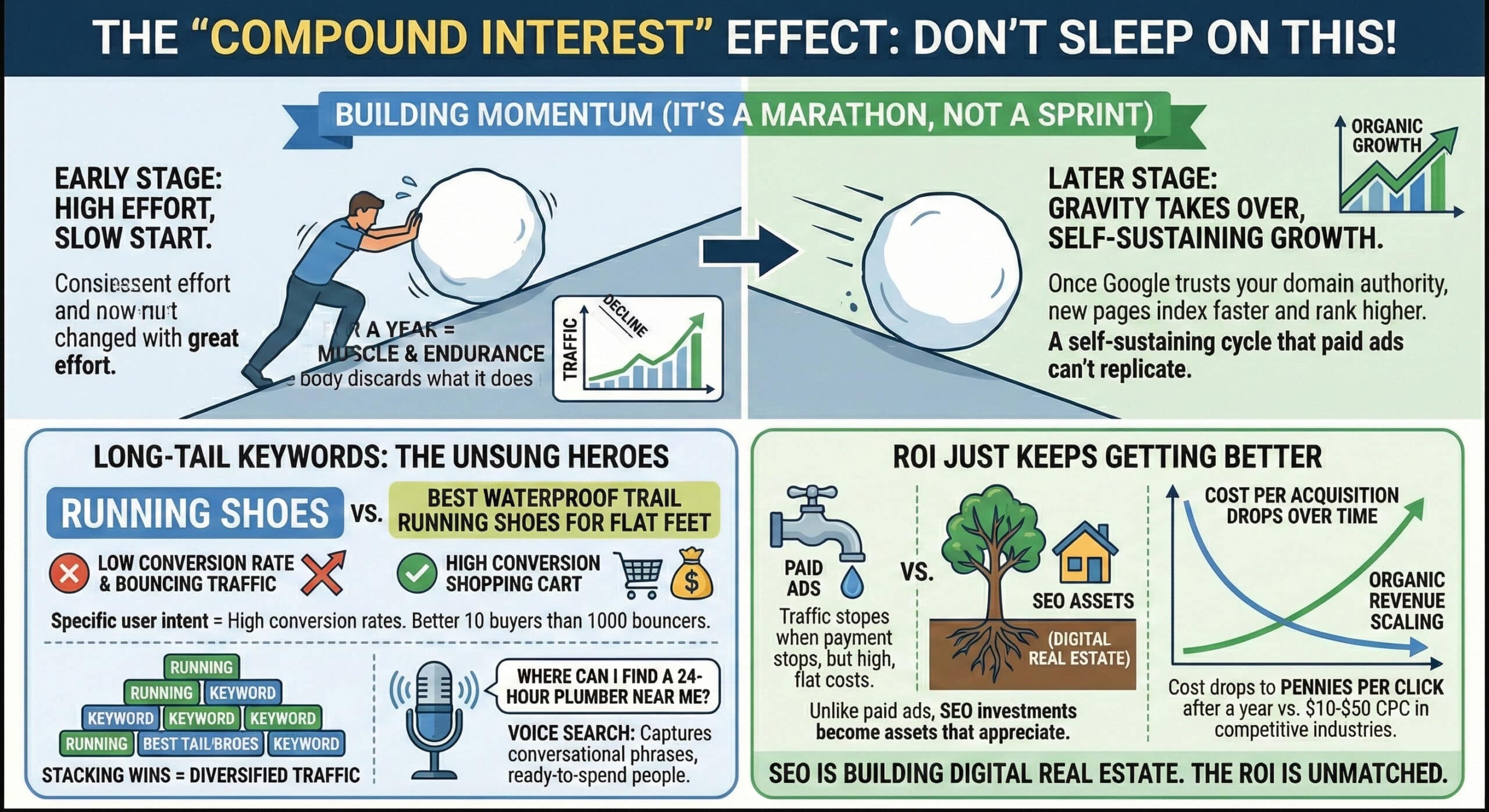
Top competitors seem to rank for everything because they have momentum. When you publish a high-quality guide, it might only get ten visits next week. But six months from now, after it has earned a few backlinks and Google has tested it against user behavior, that same content could bring in hundreds of organic visitors every month without any more work.
Think of it like pushing a snowball down a hill. At first, it takes a lot of effort. But eventually, gravity takes over. Once Google trusts your domain authority, new pages index faster and rank higher with less effort. This creates a self-sustaining cycle of growth that paid ads cannot replicate.
Long-Tail Keywords: The Unsung Heroes
Why fight for a generic term like “running shoes” when you could own “best waterproof trail running shoes for flat feet”? The real money is in the long tail, where user intent is specific and conversion rates are high. You might only get 50 visitors a month from that query, but if 10 of them buy something, that is better than 1,000 visitors who bounce immediately.
Stacking these wins is where the strategy becomes powerful. One long-tail keyword will not change your business, but ranking number one for three hundred of them will. This creates a diversified stream of traffic that provides a safety net that high-volume keywords cannot offer.
Voice search is changing how this works. People ask full questions like, “where can I find a 24-hour plumber near me who takes credit cards?” Capturing these conversational phrases puts you in front of people ready to spend money now.
ROI Just Keeps Getting Better
Think about how much you would have to pay for the same traffic through paid ads. The beauty of ongoing SEO is that your cost per acquisition drops over time. The content you paid for last year is still working for you today. Unlike paid ads, where the traffic stops when you stop paying, your SEO investments become assets that appreciate in value.
You are building real estate on the internet. Once the foundation is laid, you only need minor maintenance. Your initial investment might be heavy, but by year two or three, your organic revenue is scaling while your costs remain relatively flat. This provides a return on investment that paid channels cannot match.
Data supports this. Most businesses see the cost of organic traffic drop to pennies per click after a year of consistent effort. In contrast, CPCs in competitive industries can easily be $10 to $50 per click. You save a fortune by being patient.
Why Ongoing SEO is a Non-Negotiable for Success
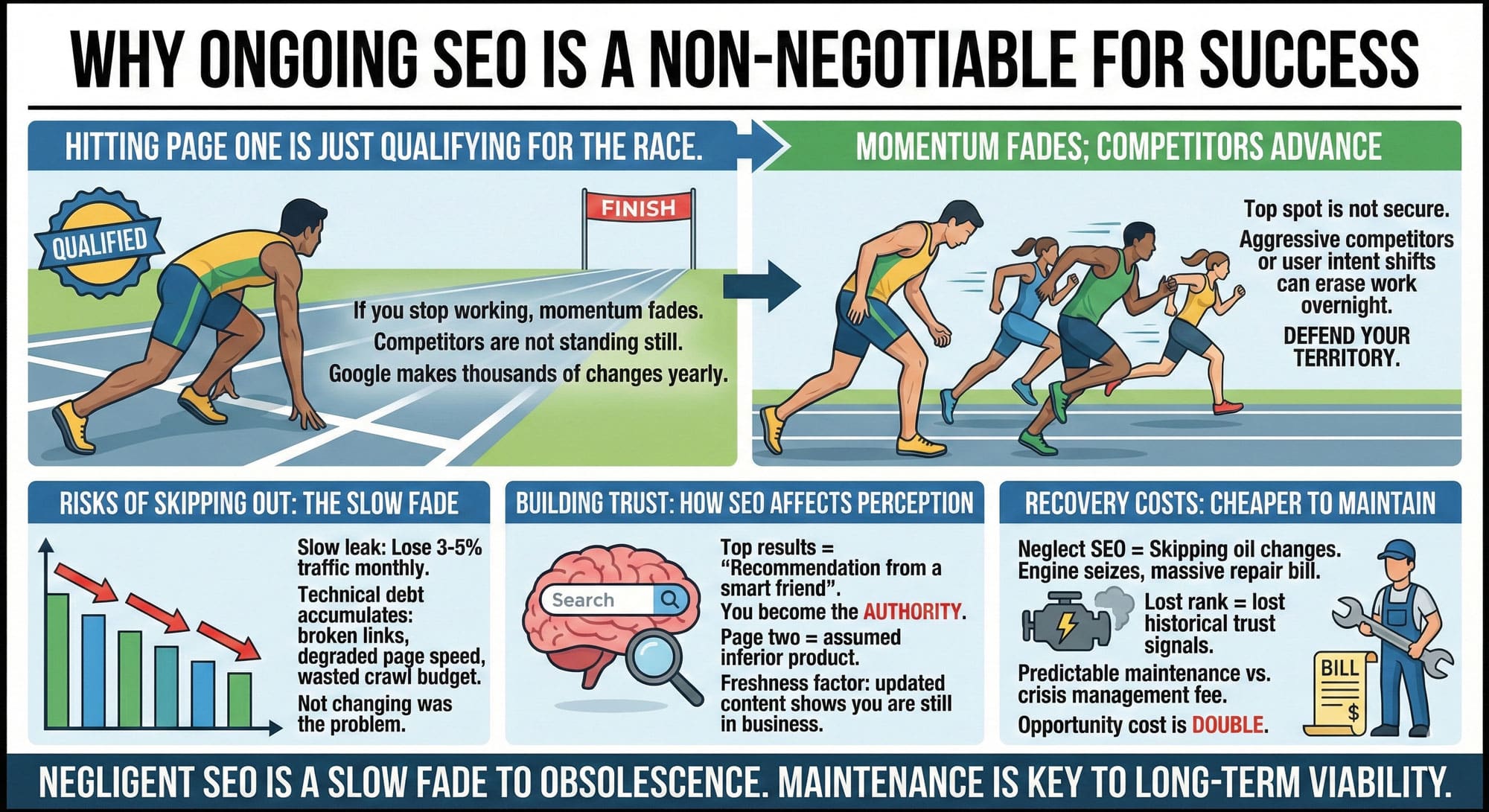
Hitting page one is just qualifying for the race. If you stop working, momentum might carry you for a few weeks, but it will not last. Google makes thousands of algorithm changes every year. If you are not actively adjusting your strategy, you are moving backward because your competitors are not standing still.
Your top spot for a keyword is not secure. An aggressive competitor or a shift in user intent can erase years of work overnight. It is not just about getting traffic; it is about defending the territory you have already claimed.
Risks of Skipping Out: The Slow Fade
The decline rarely happens with a sudden crash. It is a slow leak, where you lose 3% of your traffic one month and 5% the next. Technical debt quietly accumulates. Broken links build up, page speed degrades, and Google’s crawl budget for your site is wasted on junk URLs.
By the time you notice the revenue drop, the damage is already done. You are left wondering why leads are down when you have not “changed anything,” failing to realize that not changing was the problem. The search landscape evolved around you, leaving your static site looking irrelevant.
Building Trust: How SEO Affects Customer Perception
People treat Google’s top results like a recommendation from a smart friend. When your site appears for a solution they are searching for, you become the authority. It is subconscious psychology.
If a potential customer has to scroll past ads and competitors to find you on page two, they automatically assume your product is inferior. Consistent visibility signals that you are a major player, not a fly-by-night operation.
There is also the freshness factor. Nothing kills conversions faster than landing on a “Latest News” section where the most recent post is from three years ago. Ongoing SEO forces you to keep content updated, which tells the user you are still in business and ready to help.
Recovery Costs: Why It’s Way Cheaper to Maintain
Neglecting SEO is like skipping oil changes to save a few dollars. Eventually, the engine seizes, and the repair bill is much higher than the maintenance costs would have been. When you lose rank, you lose traffic and the historical trust signals that take months or years to earn back.
You have to spend a massive budget on technical audits, content creation, and link building just to get back to where you started. It is the difference between a predictable monthly retainer and a crisis management fee.
While you are fixing broken redirects and toxic backlinks, you are not targeting new keywords or expanding your reach. You are playing catch-up while the market moves on, meaning the opportunity cost is double what you think.
Did You Know There Are Different Types of Ongoing SEO?
Treating search engine improvement as a single line item is a quick way to waste money. You would not hire a plumber to fix your roof. SEO works the same way. It is split into distinct disciplines, and depending on your business, you might need to focus on one more than others. It is about applying the right pressure in the right spot.
You need to understand where your efforts are going. If you are investing in content but your site takes ten seconds to load, you are spinning your wheels. To keep moving forward, your strategy should cycle through these core pillars:
- Technical maintenance to keep the site readable for bots
- Content creation to capture new search queries
- Link building to grow your site’s authority
- Local improvement to capture nearby customers
| SEO Type | Primary Goal & Action |
|---|---|
| Technical SEO | Ensures the website is crawlable, fast, and error-free so Google can index it. |
| On-Page SEO | Refines individual pages, headings, and meta tags to match specific keyword intent. |
| Off-Page SEO | Builds authority and trust through backlinks, PR, and brand mentions from other sites. |
| Local SEO | Focuses on appearing in the “Map Pack” and local listings for geographically specific searches. |
| Content SEO | Produces fresh, relevant articles and guides to answer user questions and drive organic traffic. |
Recognizing which lever to pull allows you to adjust your strategy before traffic dips.
Local SEO vs. National SEO: What’s the Difference?
If you run a dental practice in Chicago, ranking for “best dentist” nationally is a waste of time. You need customers in your zip code. Local SEO focuses on geographical relevance, relying heavily on your Google Business Profile and consistency across local directories. It is less about high-volume keywords and more about “near me” intent, ensuring your name appears in the Map Pack.
National SEO is different because you are competing against everyone. The competition is fierce, and the keywords are broader. You have to rely on high-authority backlinks and long-form content to prove you are the best resource in the country. While local is about reputation and proximity, national is a war of authority and content depth.
Technical SEO: It’s Not Just for Nerds
This is basically health insurance for your website. You can write the most brilliant blog post, but if Google’s bots hit a “404 Error,” no one will read it. This part of ongoing SEO involves fixing broken links, improving site speed, and ensuring your XML sitemap is updating correctly. It is not glamorous, but ignoring it is like trying to drive a sports car with a banana in the tailpipe.
It is getting more important because Google updates now target user experience. If your site shifts while loading or takes too long to become interactive, your rankings will be penalized regardless of your content. You must constantly monitor your Core Web Vitals in Search Console because code rots over time. Keeping the backend clean ensures the frontend can do its job.
Think of technical SEO as the foundation of a house. You can decorate with expensive furniture (content) and invite neighbors over (backlinks), but if the foundation is cracked, the whole thing sinks. It requires regular audits to catch issues like duplicate content before they confuse search engines. Staying on top of the technical side removes friction between your website and the top of the search results.
Content Marketing: The Heart of SEO
Google has an insatiable appetite for freshness. You cannot publish five pages in 2019 and expect to hold your position forever. Content marketing in an ongoing SEO context means consistently publishing new insights, case studies, or guides that prove you are still active and relevant. It signals to search engines that your site is a living entity, not a digital brochure.
It is not just about churning out 500-word blog posts. You have to create content that targets gaps in your current strategy. Maybe you rank for “running shoes” but are invisible for “how to lace running shoes for high arches.” By identifying these missing pieces, you cast a wider net. It is about answering the specific questions your customers are asking now.
This is also where you show your expertise, experience, authority, and trust (E-E-A-T). When you consistently put out high-quality information that solves real problems, you naturally attract backlinks. This creates a flywheel effect. Good content brings in traffic and links, which boosts your domain authority, making future content rank faster. Viewing content as a one-time setup is the quickest way to lose your audience.
The Monthly Retainer: What You’re Really Paying For
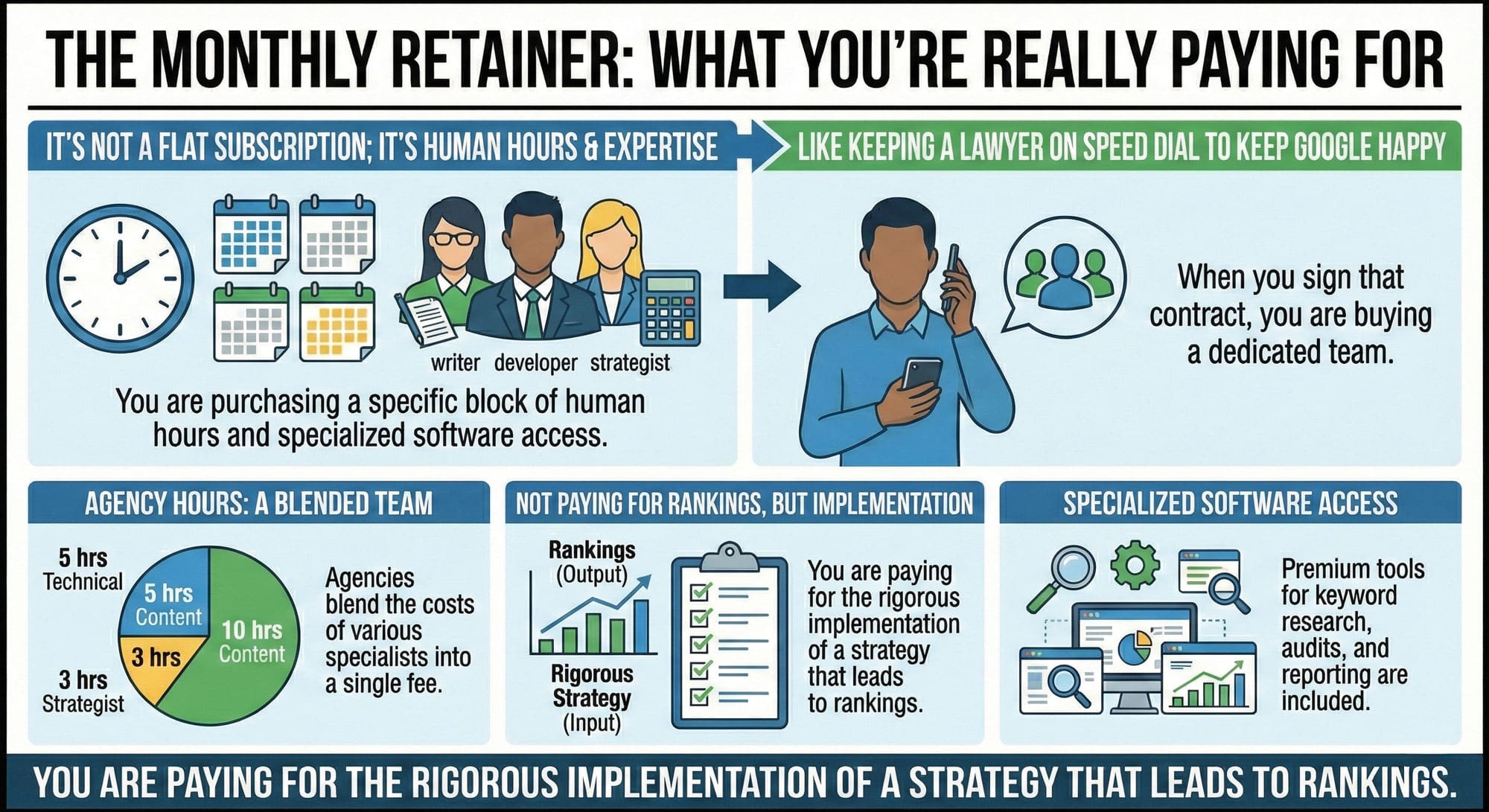
A retainer is not a flat subscription fee; you are purchasing a specific block of human hours and specialized software access. It is like keeping a lawyer on speed dial to keep Google happy. When you sign that contract, you are not paying for rankings. You are paying for the rigorous implementation of a strategy that leads to rankings.
Agencies blend the costs of various specialists into this single fee. You might get five hours of a technical expert, ten hours of a content writer, and three hours of a strategist’s time. Hiring these roles in-house would cost over $150,000 a year, so the retainer fractionalizes that expertise.
Breaking Down the Costs: What’s Fair?
Cheap SEO is almost always more expensive in the long run. Cleaning up a toxic backlink profile or recovering from a penalty costs a fortune. If an agency quotes you $500 a month, do the math. At a standard agency rate of $150 an hour, that buys you three hours and twenty minutes of work. What can be done in three hours? Not much that will move the needle against a competitor spending five thousand.
Fair pricing is usually between $1,500 and $5,000 a month for small to mid-sized businesses. About 20% of that goes to enterprise software costs like Ahrefs, Screaming Frog, and Semrush. The rest covers the human brainpower needed to interpret the data. You get what you pay for, and bargain hunting usually lands you with automated spam that hurts your domain authority.
Understanding Deliverables: No More Mystery!
Vague invoices that just say “SEO Services” are a red flag. Demand an itemized breakdown. You need to see exactly where the time went, whether it was four hours writing blog posts, two hours fixing 404 errors, or three hours on outreach. If your agency cannot tell you what tasks were completed, they probably did not do much.
Real deliverables are tangible assets. You should receive Google Docs with new copy, spreadsheets showing new backlinks, and technical audit logs showing what was fixed. It is not enough to see a graph go up; you need to know why it went up.
Do not accept a ranking report as a deliverable. A ranking report is a result, not the work. Ask for a “Change Log” or an “Implementation Report” that lists every modification made to your website during the month. If the agency disappears, you need to know what they changed.
How to Maximize Your Monthly Investment
Silence is the enemy of ROI. The clients who get the best results treat their SEO agency like an extension of their marketing team. If you launch a new product, tell your SEO team immediately so they can adjust the keyword strategy to focus on high-value pages.
Feeding them raw materials makes their job easier and your results faster. Send them photos, customer testimonials, or notes from a sales call. A good content writer can turn your rough bullet points into a powerful blog post, but they cannot read your mind.
Connect your sales team directly with your SEOs at least once a year. Your sales team knows what questions customers are asking, and those questions are gold for creating content that converts.
Getting Better at SEO: Tips from My Experience
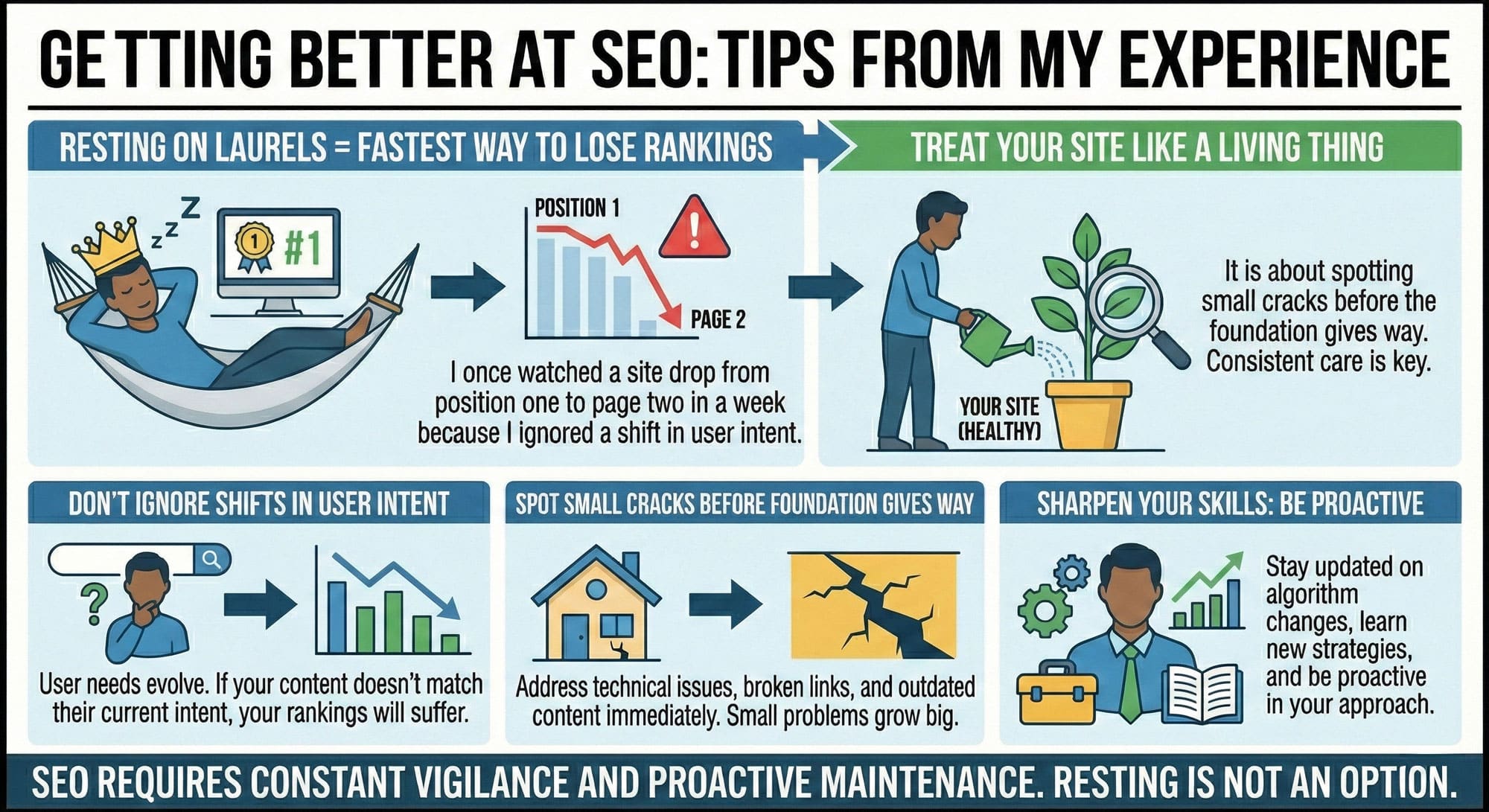
Resting on your laurels is the fastest way to lose rankings. I once watched a site drop from position one to page two in a week because I ignored a shift in user intent. You have to treat your site like a living thing. It is about spotting small cracks before the foundation gives way. To sharpen your game, focus on these ongoing habits:
- Refresh your old content with new stats and examples because Google values freshness.
- Audit your internal links to ensure your high-authority pages are passing value to newer posts.
- Watch the SERPs for your main keywords manually. Tools miss things that your eyes will catch.
You cannot rely on best practices from a few years ago and expect to win in a world of AI overviews. It takes a mindset of continuous learning.
Learning from Analytics: What the Numbers Mean
I recall seeing a massive traffic spike for a client, only to realize the bounce rate was nearly 100% because we were ranking for an irrelevant term. It is easy to get addicted to vanity metrics like pageviews, but those numbers can be misleading. You need to dig deeper. Look at engagement time and scroll depth to see if people are actually reading your content.
Do not ignore pages with zero traffic. If you have fifty blog posts that have not seen a visitor in six months, you are carrying dead weight that could be hurting your domain’s authority. Sometimes the best move is not creating new content, but pruning the old. Use your analytics to find the losers, then decide if they need a rewrite or a redirect.
Experimenting with New Strategies: Why Not?
One time, I changed all the title tags on a product category to questions instead of statements. The click-through rate jumped by 4% in three days. Most SEOs are afraid of breaking something that is working, but being too safe is how you get surpassed. Set aside a small portion of your site as a sandbox.
Try implementing FAQ schema or testing long-form content on a topic dominated by short definitions. If it fails, revert the changes. You have only lost a bit of time. But if it works, you have found an edge that keyword tools have not discovered yet.
Testing is not just for technical tweaks. Try different content angles, like taking a contrarian stance on a popular industry topic. Data from your own failures is often more valuable than success stories because it applies directly to your audience. Go break some stuff.
Staying Updated: How Do You Keep Up?
I woke up one Tuesday to an algorithm update that nuked a strategy I had been using for two years. The only reason I did not panic was that I had seen chatter building on forums the week before. The landscape shifts constantly. You do not need to read every Google patent, but you do need to keep a finger on the pulse of the community.
Curate a Twitter list or an RSS feed of experts who run tests rather than just repeating news. If you are not reading about what is changing, you are already behind. Be careful not to react to every small fluctuation; sometimes the best reaction is to do nothing and wait.
Join a mastermind group or a private Slack channel where people share real results, not just polished case studies. When you see five other people complaining about the same drop in image search traffic, you know it is a systemic issue and not just your mistake. This shared intelligence is invaluable.
The Role of Content in Ongoing SEO
I used to think I could write ten killer pages and walk away. I quickly realized that if your site sits static for months, search engines assume you have gone out of business. You have to keep the pulse beating. It is not about adding more pages for volume; it is about signaling to Google that you are still active and relevant.
Think of your content like a garden. If you do not water it, weeds take over. Updating old posts with new stats and adding internal links keeps the crawler coming back. It tells the algorithm your site is a living resource, not a digital archive. Google prioritizes living resources.
Blogging Regularly: What to Write About
Look at your sent emails. The questions clients ask every day, “how much does X cost?” or “what happens if I ignore Z?”, are your goldmine. If one person emails you about it, fifty people are Googling it. You are sitting on a mountain of data about what your audience needs.
Answer those questions publicly. Create a post that details the exact process you explained to a confused customer last week. This targets high-intent, long-tail keywords and saves you time on customer support. When the next person asks that same question, you send them the link. It is efficient, helpful, and gives search engines the helpful content they want.
Case Studies and Service Page Updates: Worth It?
Think about the last time you bought something expensive. You looked for proof that it works. That is what case studies do. They are SEO fuel because they naturally target “problem + solution” keywords. When you detail a specific project, you use the niche vocabulary your potential clients use when they are ready to buy.
Do not let your main service pages rot. I have seen sites where the “About” page still lists employees who left three years ago. Updating your core pages with recent project wins or refined service descriptions keeps the content fresh and improves your E-E-A-T score.
- SaaS Churn Reduction: A project management tool updated their “Enterprise Solutions” page with a case study showing a 14% churn reduction for a client. This led to a 40% increase in demo requests for that feature.
- Local HVAC SEO: A plumbing company added a “Recent Jobs” section to their city landing pages, detailing a complex boiler repair in a specific zip code. Their local map pack ranking moved from #7 to #2 within 30 days.
- E-commerce Conversion: An online furniture retailer added “Before and After” photos to their product pages. Organic traffic increased by 22% year-over-year, and time-on-page jumped from 45 seconds to 2 minutes.
- Legal Firm Authority: A personal injury firm published a breakdown of a $1.2M settlement, explaining the specific laws used. This single post attracted 15 high-quality backlinks from legal directories.
This builds authority. Google’s systems are looking for evidence of real-world experience. When you detail how you fixed a problem, you prove you are not just generating generic advice. You are showing your work. This distinct data is something a content farm cannot replicate.
- Manufacturing Efficiency: A logistics company published a white paper about saving a distributor $50k annually. The page now ranks #1 for “logistics cost reduction strategies” and drives 15 qualified leads a month.
- Dental Patient Acquisition: A cosmetic dentist updated their “Invisalign” page with a patient’s photo diary. This reduced their bounce rate by 18% and increased consultation bookings by 25%.
- Marketing Agency Results: An agency updated their portfolio with specific ROI numbers. One case study highlighting a 300% ROAS became their top landing page for organic search.
- Cybersecurity Trust: An IT firm released a post-mortem analysis of a ransomware attack they stopped. This technical deep-dive got picked up by a major tech forum, driving over 2,000 referral visits in a week.
User-Generated Content: Tapping into Your Fans
A sneaker shop owner let people post unboxing photos on his product pages. Sales and rankings went up. Why? Because users use natural, messy language like “comfy for wide feet” or “soles don’t squeak.” This is semantic gold. Reviews, testimonials, and Q&A sections generate free text that keeps the page living and breathing.
It also creates a community. When a new visitor sees a conversation happening, the trust factor increases. Search engines see this activity and interpret it as a high-value destination. You are crowdsourcing your long-tail keyword strategy.
You have to monitor it for spam, but the trade-off is massive. When Google sees a page getting new comments or reviews every week, it flags that URL as high-activity. User questions often highlight gaps in your content that you can fill in later.
The Power of Social Signals: Should You Care?
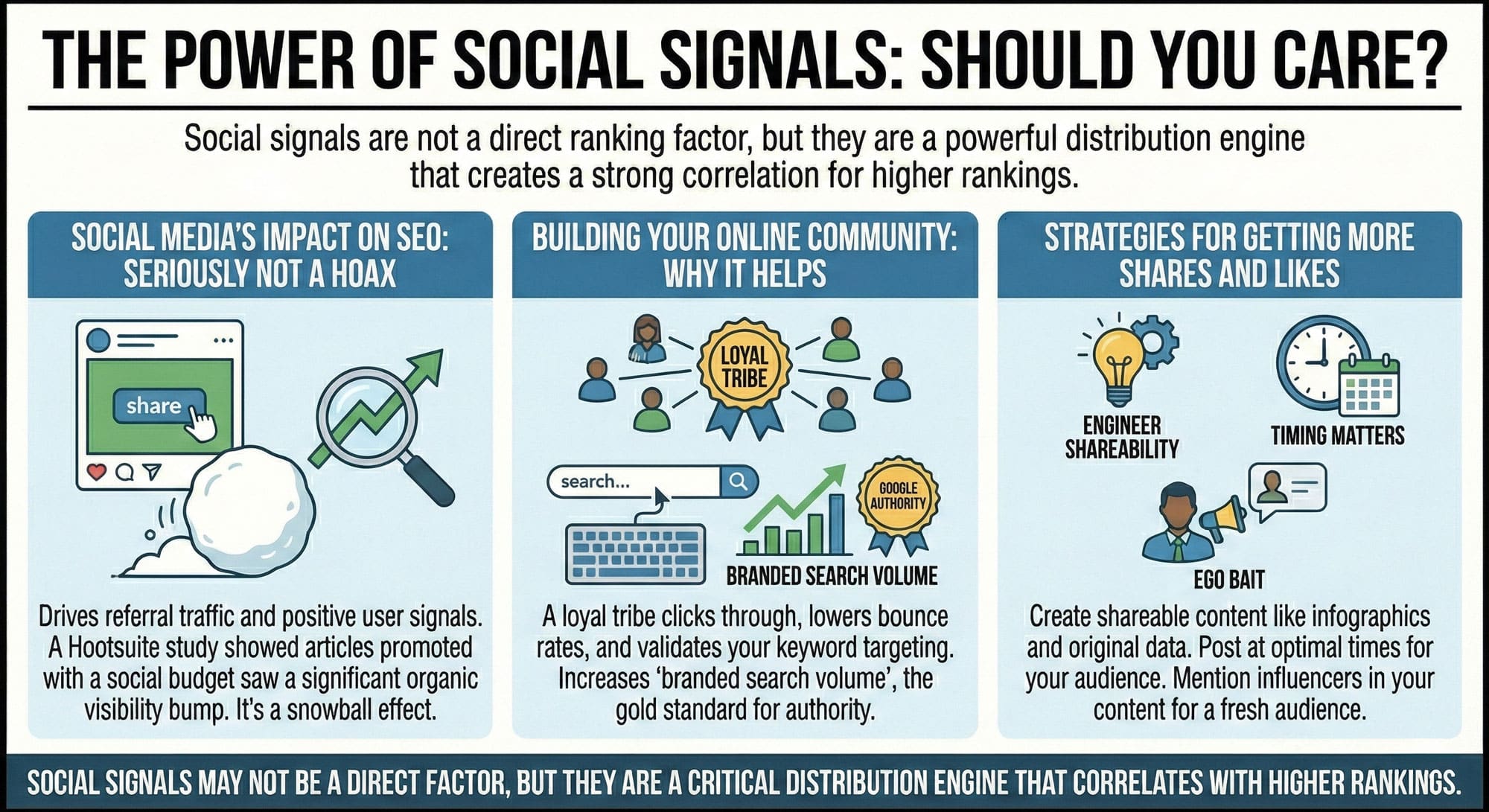
Google has denied for years that social signals are a direct ranking factor, but there is a correlation you cannot ignore. Pages ranking in the top spots almost always have heavy social traction.
Think about it. If no one sees your content on their feed, they will not link to it from their blogs. Social media is your distribution engine. Without that initial push, your article sits in a vacuum.
Social Media’s Impact on SEO: Seriously Not a Hoax
People often think social media is just for brand awareness, but it drives “referral traffic.” When you drop a link that gets shared five hundred times, you are sending positive user signals to search engines that say, “this page is interesting.” A Hootsuite study tested this and found that articles promoted with a social budget saw a significant bump in organic search visibility.
It creates a snowball effect.
Social buzz leads to organic searches for your brand, which Google tracks as a trust signal. If an article goes viral on Reddit, you will see a spike in people searching for your site name plus the topic. This trains the algorithm that you are the authority on that subject.
Building Your Online Community: Why It Helps
You do not need a million followers. A small, hyper-active community does more for your SEO than a massive ghost town. When you have a loyal tribe, they click through, stay on the page, and lower your bounce rates. These metrics tell Google your site satisfies user intent.
A returning visitor from your community is more likely to engage with the site and convert than a cold lead. These users provide the engagement data that validates your keyword targeting.
Plus, these people start typing your brand name directly into the search bar. This increases your “branded search volume,” which is the gold standard for authority in Google’s eyes. It proves you are a recognized entity.
Strategies for Getting More Shares and Likes
Posting a link and begging for a retweet is the worst way to do this. You have to engineer your content for shareability. Think controversial opinions, original data studies, or infographics. People share things that make them look smart.
Timing matters. If you are B2B, posting at 9 AM on Tuesday hits the morning commute crowd. B2C content might perform better on weekends. You have to test this for your audience.
Another trick is “ego bait.” Mention influencers or other brands in your content and tag them when you share it. They will almost always share it to show off the mention, putting your link in front of a fresh audience.
The Secret Sauce: Combining SEO with Other Marketing Strategies
Businesses often treat search improvement like it is completely separate from the rest of marketing. But real growth happens when you break down these silos. Think of your ongoing SEO efforts as the bass player in a band. It provides the rhythm that holds everything else together.
When you align your search data with social or paid campaigns, you create a multiplier effect that makes every dollar work harder. You take the keywords driving organic traffic and feed them into other channels, creating a powerful feedback loop.
SEO and PPC: A Match Made in Heaven
Paying for traffic you could get for free sounds crazy, but smart marketers do it for real estate domination. When you run ads on the exact terms you rank for organically, you push a competitor off the first page and double your chances of a click. You tell the searcher you are the authority.
PPC is also your crystal ball. Instead of spending six months trying to rank for a term that does not convert, you can spend fifty dollars on Google Ads and know by tomorrow if that keyword is worth your time. It takes the guesswork out of your long-term content strategy.
Email Marketing: Don’t Underestimate Its Power
Google may not count social signals directly, but a flood of highly engaged traffic from your newsletter gets the algorithm’s attention. When you send a blast linking to your latest article, you are sending hundreds of people who already like your brand to your site. They stay longer and bounce less.
These user signals are gold. Google sees this engagement and assumes the content is incredible, which can help that page rank higher for everyone else.
Do not reinvent the wheel. Take your high-performing blog posts and repurpose them into a nurture sequence for new subscribers. You keep your list warm with proven value and get fresh eyes on older content.
Influencer Marketing: Gaining Credibility
Influencers are secret weapons for building your site’s domain authority. If you get a niche expert to mention your brand or link to your research on their blog, you are borrowing their trust.
Google looks at who links to you as a vote of confidence. A single link from a recognized industry leader can outweigh a hundred links from directory sites.
Try co-creating content instead of paying for a shoutout. Interview an expert for your blog. They will almost certainly share it and link to it. This creates a natural link-building engine and boosts your E-E-A-T score by associating your content with recognized authorities.
How to Track Your Ongoing SEO Progress
Tracking SEO is not just about refreshing Google to see if you moved from position six to four. Real tracking is about spotting trends before they become problems. It is about understanding that a drop in rankings might be fine if your overall organic revenue is up because you are attracting better-qualified visitors.
You cannot manage what you do not measure. The goal is to establish a baseline and watch the changes. Are you gaining visibility for topics that drive business? Is your click-through rate improving even if your position is static? These are the nuances that separate a panicked site owner from a strategic one.
The Right Tools: What Should You Be Using?
You do not need every shiny SaaS platform. You only need a few heavy hitters. Start with Google Search Console. It is the only source of truth from Google, and ignoring it is like driving with a blindfold on. It is free and shows you the exact queries people use to find you and highlights technical errors.
For competitive analysis, choose either Ahrefs or Semrush. You do not need both. They do the same job of showing you backlink profiles and keyword gaps. Pick one, learn it, and stick with it. Then, grab a crawler like Screaming Frog for deep technical audits. That is it.
Setting KPIs: What to Measure?
Many site owners get obsessed with total session numbers. But if that traffic is hitting a low-value blog post and bouncing, it is worthless. You have to tie your SEO efforts to business goals. Focus on organic conversions. Are people filling out forms? Are they buying? If your rankings go up but revenue stays flat, you are targeting the wrong keywords.
Instead of just staring at traffic graphs, look at keyword velocity. How fast are new pages getting indexed and ranking? This tells you how much authority your site is building. Also, monitor engagement metrics like time on page for your key landing pages. If Google sends you traffic and users leave in ten seconds, that ranking will not last.
Do not ignore the technical stuff. Keep an eye on your Core Web Vitals and index coverage. These are leading indicators. If your number of ‘valid pages’ in the index suddenly drops, you have a technical issue that will hurt your rankings if you do not fix it now.
Analyzing Results: What If Things Aren’t Working?
The immediate instinct when a graph goes red is to panic and start changing everything. Stop. First, check if the drop is sitewide or isolated to specific pages. If it is just one page, you likely lost a specific keyword ranking. That is an easy fix.
If it is the whole site, check your technical health or see if Google rolled out a core update. Sometimes, nothing is broken. You might just be seeing a correction. Dig into the GSC performance report and compare dates. Did impressions drop, or just clicks? If impressions are stable but clicks are down, a competitor might have a better title tag or a Featured Snippet.
Sometimes the problem is not your SEO at all. It is seasonality. If you sell snowboards and traffic tanks in July, that is not a penalty. Always layer your traffic data over year-over-year comparisons to see if this is a pattern or an anomaly. Context is everything.
Common Pitfalls in Ongoing SEO
It is easy to assume you can set everything on autopilot once you have a strategy. But that mindset is where things go wrong. You might get comfortable publishing the same type of content, only to see your traffic dip 15% because the algorithm shifted.
Consistency in the wrong direction just gets you to the bottom faster. You have to stay agile. If you are blindly following a checklist from a few years ago, you are not doing ongoing SEO. You are doing ongoing damage control. The landscape changes too fast for static plans.
Avoiding Shortcuts: Why They Bite Back
You might get spam emails promising “DA 50+ backlinks” for five bucks. It is a trap. Google’s spam detection is smarter than it used to be, and those toxic links are radioactive waste for your domain authority. You might see a temporary bump, but the penalty will be severe.
Maybe you are thinking about creating hundreds of AI-generated pages without a human editor. Do not do it. The cleanup cost for a manual penalty is insane compared to doing it right the first time. You will spend six months recovering from a penalty that took two weeks to earn.
Overlooking the Basics: Don’t Get Too Fancy
There is a tendency to chase shiny new toys like preparing for voice search or complex schema markup. But half the time, the sites chasing these tactics have broken internal links or images that take four seconds to load. You cannot build a penthouse on a foundation of wet cardboard. If your title tags are duplicated, no amount of advanced fixes will save you.
Fix the leaks in the boat before you buy a new engine. Review your Google Search Console for basic crawl errors. Ensuring your site hierarchy makes sense is what allows advanced strategies to work.
Think about Core Web Vitals, specifically LCP (Largest Contentful Paint). If your main header image takes 3.5 seconds to load, you are failing a basic test that directly impacts rank. Resizing images and minifying CSS moves the needle more than most “advanced” strategies.
Ignoring Your Audience: They’re the Real Bosses Here
We can get so buried in keyword difficulty scores that we forget actual humans have to read this stuff. You might trick the algorithm into ranking a page, but if the content is unreadable, the user will bounce back to the search results in three seconds. High bounce rates send a clear signal that your result is irrelevant.
You have to solve the user’s problem. If you do not answer their question immediately, you have lost them, and you will eventually lose the ranking. Google’s business model relies on satisfying users. If you fight against user experience to satisfy a bot, you are fighting a losing battle.
This often happens when you misunderstand search intent. If someone searches “how to fix a leaky faucet,” they want a tutorial, not a sales page. If you serve them a sales pitch, you have ignored their needs, and Google will notice.
Summing up
With search engines pushing AI snapshots to the top of results, resting on your laurels is not an option. The digital landscape is shifting constantly. If you think hitting page one today means you will be there next month without lifting a finger, you are in for a rude awakening. The competition never sleeps.
It is about staying relevant when the algorithm throws a curveball.
At Dotarus, we see this as building a sustainable digital system. You have to keep feeding the machine by building quality links, improving your site speed, and refreshing old content. It is a grind, but you must keep pushing and refining your strategy to ensure your business does not disappear into the digital void.
See it in practice
We put this into practice for Trifecta Roofing and Restoration — read how it played out.
FAQ
What exactly is ongoing SEO?
Treating your website like a static brochure is the fastest way to kill your organic traffic. Ongoing SEO is the regular maintenance required to keep your site performing well in Google’s eyes because the internet does not stand still. It is not a one-time setup; it is a routine. Think of it like going to the gym. You cannot work out once in January and expect to stay fit all year. You have to keep showing up. In the SEO world, this means creating fresh content, fixing technical glitches, and building authority through backlinks. It is about adapting. Search engines change their rules, and your competitors are trying to outrank you. Ongoing SEO is your defense against fading into obscurity.
Why can’t I just do SEO once and be done with it?
Google cares more about what you have done recently than what you did three years ago. If you stop working on your site, it experiences “content decay.” Your information gets old, links break, and newer websites start pushing you down the rankings.
Plus, user behavior changes. What people searched for last year might not be what they are typing today. If you are not adjusting your keywords and strategy, you are missing out on traffic.
You cannot win a race if you stop running. Competitors are always hungry for your spot. If you take your foot off the gas, someone else will speed past you.
What tasks are actually included in ongoing SEO?
It is a mix of technical fixes, creative writing, and digital PR. Most months, this involves digging into data to see what pages are slipping and figuring out why. Maybe a page needs more text, or it loads too slowly on mobile. Then there is the content side. You need to publish new blog posts or update old guides to keep them relevant. Google loves fresh content.
You are also looking at off-page factors. This means getting other reputable sites to link back to you, which tells search engines you are legitimate. It is a grind, but it pays off.
How long does it take to see results from this monthly work?
Anyone promising overnight rankings is trying to sell you something unrealistic. SEO is a slow burn, like investing or growing a tree. You usually start seeing movement around the three to six-month mark, but the real compounding results happen after a year or more.
It can be frustrating. You might produce great articles for weeks and see the needle barely move. But then, things start to click as authority builds.
Patience is the only shortcut here.
Once you gain momentum, it is hard to stop. Unlike ads where traffic dies when you stop paying, SEO builds an asset that keeps working for you long-term.
Is paying for ongoing SEO better than just running ads?
Renting your traffic through ads is fine, but owning your traffic through SEO is how you build real value. When you pay for PPC, you get visitors instantly. But the moment your budget runs out, your site becomes a ghost town again. Ongoing SEO is about building equity in your website. It is cheaper in the long run because you are not paying for every click. You are earning them.
Sure, it takes longer to get going. But eventually, your cost per acquisition drops significantly because you are getting thousands of visitors “for free” from organic search. For long-term growth, it is usually the smarter play.