
Texas Just Redefined Text Marketing: Your Complete SB 140 Compliance Guide
Texas SB 140 redefines marketing texts as telemarketing, exposing businesses to registration requirements and private lawsuits. Our comprehensive Texas SB 140 compliance guide provides the essential steps to manage consent, follow new rules, and avoid significant legal risks before the September 2025 deadline.
Over the coming months you need to prepare: SB 140 reclassifies promotional SMS/MMS and images as telemarketing, exposing you to registration (Form 3401, $200 fee, $10,000 bond), strict quiet hours, mandatory documented prior express written consent with instant opt-out and full record-keeping, and private lawsuits under the Texas Deceptive Trade Practices Act; exemptions are narrow and vague, so if you text Texas residents for marketing you should assume telemarketing rules apply or register to avoid serious legal risk.
Key Takeaways:
- Effective Sept 1, 2025, SMS, MMS, graphics, and images that push goods or services are legally defined as “telemarketing.”
- Telemarketers must register with Texas: file Form 3401, pay a $200 annual fee, post a $10,000 bond or letter of credit, and renew yearly.
- Texas residents have a private right of action under the Texas Deceptive Trade Practices Act — consumers can sue and repeat violations allow continued suits.
- Operating restrictions: marketing texts allowed only 9 a.m.–9 p.m. Mon–Sat and after noon on Sundays; required documented prior express written consent, instant opt-out, and full recordkeeping of opt-ins/messages.
- Exemptions are vague and limited; if you text Texas residents via GHL or any platform, assume telemarketing rules apply or register to avoid litigation risk.
The Legal Landscape of Telemarketing in Texas
Redefining Telemarketing: SMS and MMS Under SB 140
SB 140, effective September 1, 2025, expressly brings SMS, MMS and any graphics or images that promote goods or services within Texas’s telemarketing definition, so a promotional photo, GIF or rich-media link you send counts the same as a call. The statute ties violations to the Texas Deceptive Trade Practices Act, meaning consumers gain a private right of action; that shifts risk from regulator-only enforcement to direct lawsuits by recipients.
If you use platforms like GHL to push offers, expect the law to treat those messages as telemarketing even when embedded in otherwise informational threads — a sale-related image or time-limited coupon in a text can trigger registration, consent, quiet-hours and recordkeeping obligations. SB 140 also mandates documented prior express written consent, instant opt-out capability and comprehensive records of opt-ins and messages, turning basic list management into a substantive legal compliance function.
Implications for Businesses: Compliance Challenges Ahead
Operational compliance will demand new workflows: filing Form 3401, paying a $200 annual fee, and posting a $10,000 bond or letter of credit if registration applies, plus annual renewals. You’ll need to segment Texas recipients, hard-stop campaigns outside the statutory quiet hours (no texts before 9 a.m. or after 9 p.m. Monday–Saturday; no texts before noon on Sundays), and retain timestamped proof of prior express written consent and any opt-outs. Litigation exposure rises because consumers can sue under the TDTPA and pursue repeat-offense claims.
Start by auditing your databases for Texas numbers, exporting opt-in metadata and message histories, and configuring GHL (or your ESP) to enforce time windows and instant opt-out handling automatically; if your customer relationships are older than two years or you think an exemption applies, document that relationship thoroughly rather than assuming immunity. If uncertainty remains, file Form 3401 and secure the bond — the filing and $200 fee are a known, controllable cost compared with the open-ended risk of consumer suits.
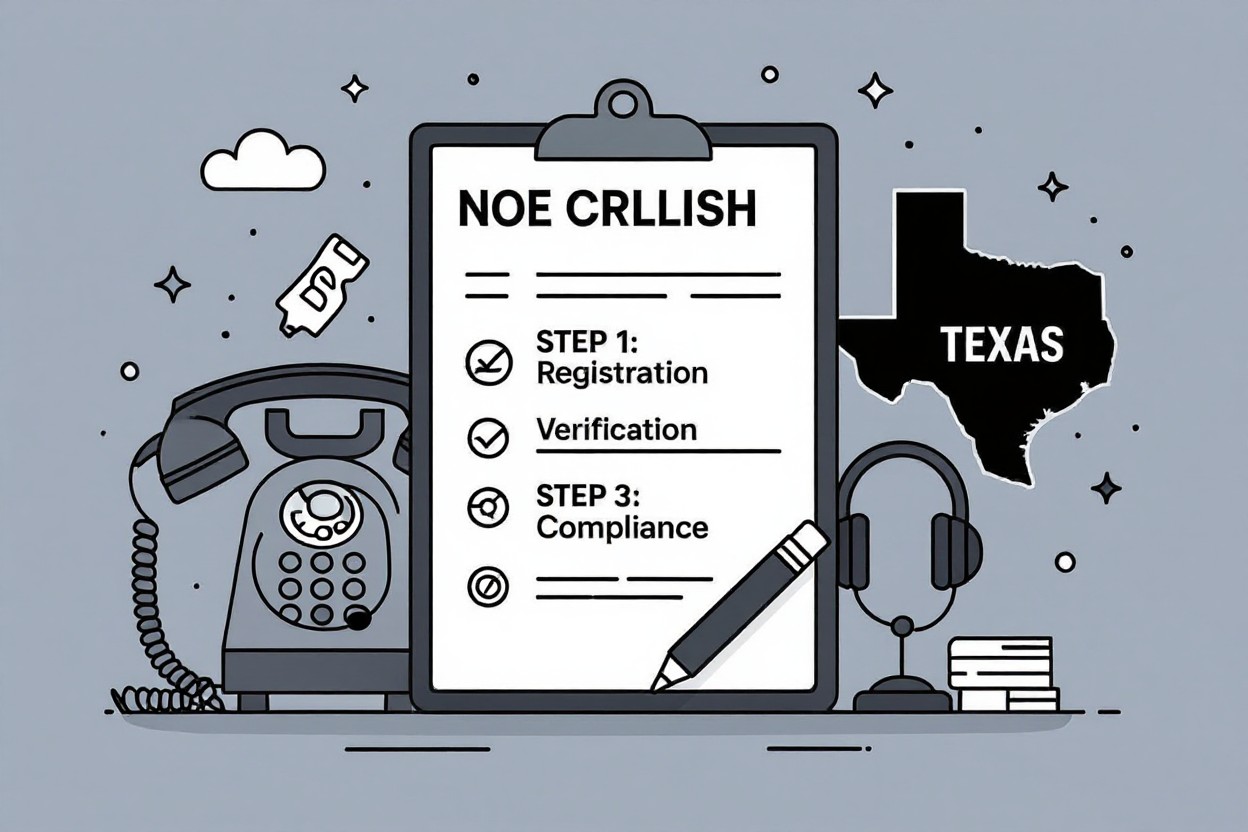
Registering for Telemarketing in Texas: A Step-by-Step Guide
| Step | What you need |
|---|---|
| Confirm status | If your SMS/MMS, images, or multimedia push goods or services to Texas residents, SB 140 treats those messages as telemarketing and likely triggers registration. |
| File Form 3401 | Submit Form 3401 to the state (use the official portal or filing address provided by Texas regulators) with your business details and designated contact for compliance. |
| Pay the annual fee | Include the $200 annual registration fee with your initial filing and plan to remit $200 each year at renewal. |
| Post security | Provide a $10,000 surety bond or an equivalent letter of credit as required to secure consumer claims under the statute. |
| Renewal & records | Renew annually, maintain documented prior express written consent for each contact, instant opt-out functionality, and full message logs for audits or litigation. |
| Operational limits | Program message schedules to honor quiet hours (no texts before 9 a.m. or after 9 p.m. Mon–Sat; no texts before noon on Sundays) and build opt-out handling into workflows. |
Essential Registration Requirements: Forms and Fees
File Form 3401 as your formal registration step and include the $200 annual fee with that submission; plan for the same $200 payment at each renewal cycle. Provide accurate business contact information and designate a responsible compliance contact so the state can reach you about any registration issues or enforcement actions.
Keep a submission checklist: completed Form 3401, payment confirmation, proof of the $10,000 bond or letter of credit, and a copy of your internal opt-in/consent records. Audits and litigation under the Texas Deceptive Trade Practices Act will focus on whether you actually collected prior express written consent and maintained accessible records tied to the registration.
Financial Commitments: Bonds and Annual Fees
Post a $10,000 surety bond or an equivalent letter of credit as part of your registration package; that bond secures consumer recovery for violations and can be drawn on if a judgment is entered under the statute. The $200 annual fee is relatively small compared with potential legal exposure, but both must be maintained every year to keep your registration active.
Bonds typically require underwriting based on your business’s credit and claims history, so expect a premium rather than the full $10,000 outlay up front—commercial surety rates often run between 1–5% annually depending on risk. Letters of credit can be more costly in terms of banking fees and collateral requirements, so compare both options during onboarding.
If you lapse on the bond or fail to renew the $200 fee, your registration can be revoked and consumers retain direct private rights to sue under the Texas Deceptive Trade Practices Act; use automated alerts for renewals and track bond expiration dates closely to avoid exposure to default judgments and repeated litigation.
The Risk of Litigation: Understanding Consumer Rights
SB 140 hands Texas consumers a stronger private right of action by explicitly tying telemarketing texts to the Texas Deceptive Trade Practices Act (DTPA). You can expect plaintiffs to challenge messages that lack documented prior express written consent, violate quiet-hour windows (no marketing before 9 a.m. or after 9 p.m. M–Sat; no texts before noon on Sun), or fail to include instant opt-outs and full opt-in records. Courts will scrutinize your recordkeeping—missing Form 3401 filings, a skipped $200 registration fee, or absence of the $10,000 bond/LOC can be used as evidence of noncompliance and aggravate claims.
Private suits scale quickly: a single claimant can seek injunctive relief, recover actual damages, and pursue attorney’s fees under the DTPA; when conduct is knowing or repeated, courts may authorize enhanced remedies such as multiplied damages and broader equitable relief. Your exposure multiplies with each unsolicited message and each Texas recipient, so a campaign that texts thousands of numbers without airtight consent can turn into high-cost litigation or class action exposure almost overnight.
The Texas Deceptive Trade Practices Act Explained
The DTPA gives consumers a broad private cause of action for false, misleading, or deceptive acts in trade or commerce; SB 140 folds SMS/MMS marketing into that rubric by labeling promotional texts as telemarketing. You must evaluate your opt-in flows, disclosures, and documentation against the DTPA’s consumer-protection standards—mere soft opt-ins or checkbox language buried in terms of service will not satisfy the “prior express written consent” SB 140 demands.
Remedies under the DTPA include actual (economic) damages, injunctive relief to stop unlawful practices, and recovery of reasonable attorney’s fees and court costs. When conduct is shown to be knowing or repeated, courts can award enhanced damages and broader equitable remedies, increasing the financial and operational impact on your business if you can’t demonstrate strict compliance (documented opt-ins, instant opt-outs, and retained message logs).
The Consequences of Non-Compliance: Lawsuits and Penalties
Regulatory penalties and private lawsuits are both on the table: failing to register (Form 3401, $200 fee, $10,000 bond/LOC, annual renewal) or to meet consent and quiet-hour rules hands plaintiffs clear grounds under the DTPA. You can be enjoined from sending further messages, required to disgorge revenues tied to unlawful campaigns, and forced to cover plaintiffs’ attorney fees—outcomes that hit small operations especially hard when combined with bond forfeiture or administrative fines.
Class-action risk rises when large lists receive noncompliant texts: a nationwide or statewide campaign that includes thousands of Texas numbers can produce multiple individual suits or a consolidated class claim, dramatically increasing defense costs and settlement exposure. Courts will factor in whether violations were avoidable—lack of documented opt-ins or sloppy opt-out processes often converts a regulatory misstep into a costly civil judgment.
Practical examples show how exposure compounds: if you sent 5,000 unsolicited promotional texts to Texas residents, each recipient could be a potential plaintiff under the DTPA and any successful suit could seek actual damages plus attorney’s fees and enhanced remedies if the conduct is found knowing or repeated—making registration, strict scheduling, and airtight recordkeeping nonoptional risk controls.
Crafting a Compliant SMS Strategy in Light of SB 140
Audit your contact lists for Texas numbers and tag every record with state, consent status, timestamp, IP, and the copy shown at opt-in; if consent is missing or incomplete, pause marketing sends until you capture documented prior express written consent. Budget for registration if you can’t confidently verify exemptions: filing Form 3401, a $200 annual fee, a $10,000 bond or letter of credit, and yearly renewal are concrete costs that change your risk calculus compared with continuing unregistered sends. Maintain an auditable trail of every opt-in and message to defend against DTPA suits—store the consent text, method (webform/SMS/phone), IP/device data, and full message logs.
Configure your platform to enforce SB 140 rules at the system level: use GHL (or your provider) to segment by state, block sends outside permitted windows, and auto-enforce immediate opt-outs with STOP handling and suppression lists. Implement conservative frequency caps (for example, no more than 1–2 promotional messages per week per contact), version-control your opt-in copy, and export quarterly compliance reports showing timestamps and delivery receipts so you can demonstrate diligence if a consumer sues.

The Importance of Consent: Best Practices for Opt-Ins
Design your opt-in language to meet “prior express written consent” standards by explicitly stating messages are telemarketing, the expected frequency, and that consent is not a condition of purchase—an example line: “I agree to receive recurring marketing texts about
from [Business Name] at this number; consent is not required to make a purchase.” Capture the exact copy presented, the checkbox state (unchecked by default), timestamp, IP address, and the page URL or form ID where consent occurred. Double opt-in (send a confirmation SMS requiring a reply) provides an extra evidentiary layer: keep the inbound confirmation message and reply time in your records.Automate opt-in verification so you can prove chain-of-custody: save server logs showing when the consent form was served, what content was displayed, and the submission payload. Use unique campaign identifiers and UTM tags on signup links to link consent to the specific creative or offer that generated it; that level of granularity helps if a consumer alleges they never agreed. Configure your system to immediately honor STOP or UNSUBSCRIBE keywords, log the timestamp and keyword, and suppress future sends—failing to process opt-outs promptly is a common trigger for DTPA claims.
Scheduling Texts: Navigating Quiet Hours Effectively
Follow SB 140’s windows precisely: schedule marketing sends only between 9:00 a.m. and 9:00 p.m. local time Monday–Saturday, and between 12:00 p.m. and 9:00 p.m. local time on Sundays. Map each contact to a timezone using a confirmed mailing address or zip code at signup rather than assuming area code equals location; then set your automation to evaluate recipient local time at send moment so a single campaign doesn’t violate quiet hours for any Texas resident. Stagger campaigns at safe anchor times—10:00 a.m., 2:00 p.m., or 6:00 p.m.—and avoid last-minute scheduling that risks crossing the 9:00 p.m. cutoff.
Implement guardrails in your stack: create a “Texas” suppression window rule in GHL, add pre-send checks that block any promotional blast outside allowed hours, and log the computed local send time with each delivery receipt. If you rely on third-party scheduling or delivery vendors, require an SLA clause that they respect recipient local time and provide delivery timestamps for audit. Conservative sending frequency (e.g., max 2 promotional messages per week) reduces consumer complaints that lead to repeat-violation suits.
To tighten your defense, validate timezone data during onboarding—ask for ZIP code and infer timezone, or call out a required phone-confirmation step for Texas opt-ins—and run regular test sends to sample Texas numbers to confirm automation respects DST changes and local send windows; keep those test logs as part of your compliance evidence.
Assessing Exemptions: Who’s Off the Hook?
Exemptions under SB 140 are limited and written with language that leaves wide room for interpretation; some nonprofits, educational institutions, and businesses claiming an established customer relationship of two or more years are named, but the statute doesn’t clearly define scope or thresholds. You’ll need to examine how your messages are framed—promotional content, images, or offers are explicitly categorized as “telemarketing,” which narrows the pool of safe activities even for organizations that might otherwise expect relief.
Cost and enforcement realities change the risk calculus: filing Form 3401, paying a $200 annual fee and posting a $10,000 bond or letter of credit are concrete, known costs, while litigation exposure under the Texas Deceptive Trade Practices Act is open-ended. If you’re weighing whether to claim an exemption, compare the administrative burden of registration against the potential for individual suits and repeated-violation claims that can multiply quickly if a campaign crosses the line.
Analyzing the Ambiguities: Entities That May Qualify
Statutory text hints that bona fide charities, schools, and long-standing business-customer relationships could fall outside telemarketing rules, but SB 140 does not supply bright-line tests for “nonprofit” status or what constitutes a two-year established relationship. You should assess whether messages are transactional (appointment confirmations, billing notices) versus promotional (discounts, offers, event solicitations); the latter are squarely within the telemarketing definition and will likely disqualify an otherwise eligible entity.
Consider a real-world example: a private school texting about open-house fundraising events with images and donation links would likely be treated as telemarketing despite being an educational institution, while the same school sending grade reports or schedule changes probably would not. You must document why a given message falls into a non-telemarketing category—timestamped records, the exact message content, and evidence of a qualifying relationship duration are the kinds of proof you’ll need if enforcement or private litigation arises.
The Dangers of Assuming Exempt Status: A Cautionary Tale
You might believe a two-year customer relationship or nonprofit mission shields you, but that assumption can be costly. Imagine a service provider with 3,500 Texas customers who sends a promotional MMS blast to drive bookings; because the content promotes goods or services and includes images, plaintiffs successfully argue it’s telemarketing under SB 140 and file DTPA claims. Legal defense costs, settlements, and the administrative scramble to register retroactively typically exceed the $200 filing fee and $10,000 bond you skipped.
One practical consequence: each recipient has standing to sue, so a single mistimed campaign sent during prohibited hours or lacking documented prior express written consent can generate dozens or hundreds of individual complaints. You should preserve opt-in records, timestamps, opt-out confirmations, and message archives for every Texas number you contact—those records are the difference between proving an exemption and facing a costly, protracted defense.
Summing up
Considering all points, Texas SB 140 transforms marketing texts into regulated telemarketing, so if you message Texas residents you must treat SMS/MMS/graphics as telemarketing communications: obtain documented prior express written consent, provide instant opt-out, adhere to quiet hours (no texts before 9 a.m. or after 9 p.m. Monday–Saturday, and not before noon on Sundays), and maintain full records of opt-ins and messages.
You may also need to register by filing Form 3401, paying the $200 annual fee, posting a $10,000 bond or letter of credit, and renewing yearly; failure exposes you to private lawsuits under the Texas Deceptive Trade Practices Act and repeated suits for repeat violations. If you use GHL or similar platforms and you’re not certain an exemption applies, you should register and tighten consent, scheduling, opt-out, and recordkeeping processes to minimize litigation risk.
See it in practice
We put this into practice for Golden Milestone Services — read how it played out.
FAQ
What is Texas Senate Bill 140 (SB 140) and when does it take effect?
SB 140 expands Texas telemarketing law so that, beginning September 1, 2025, text-based communications that promote goods or services are treated as telemarketing. The expansion explicitly covers SMS, MMS and image/graphic messages used to market or solicit sales.
Which types of messages and content are covered by SB 140?
Any text-based marketing to Texas residents is covered: SMS, MMS, multimedia messages, and images or graphics that communicate offers, promotions, or solicitations for goods or services. Purely informational or transactional messages that do not promote goods or services may be treated differently, but marketing content is squarely within the statute.
Do I need to register with Texas to send marketing texts, and what does registration require?
Many senders will need to register as telemarketers. The registration process includes filing Form 3401, paying a $200 annual fee, and posting a $10,000 surety bond or letter of credit, with annual renewal required. Whether a particular sender must register can depend on exemptions and factual details, so plan for registration unless you have a clear, documented exemption.
What consent, opt-out, and recordkeeping requirements does SB 140 impose?
SB 140 requires documented prior express written consent for marketing texts, a simple and immediate opt-out mechanism in every message, and comprehensive recordkeeping of opt-ins and sent messages. Maintain clear, retrievable records of consent and message history to demonstrate compliance if challenged.
How is SB 140 enforced and how does it affect platforms like GHL?
Enforcement includes private actions under the Texas Deceptive Trade Practices Act: consumers can sue violators and may file additional suits for repeat violations. The law also imposes quiet hours (no marketing texts before 9 a.m. or after 9 p.m. Monday–Saturday; none before noon on Sundays). For platforms such as GHL, any marketing texts to Texas residents are subject to telemarketing rules — meaning senders must ensure compliant consent, timing, opt-outs, recordkeeping, and likely registration to avoid civil liability.