Hmong Network
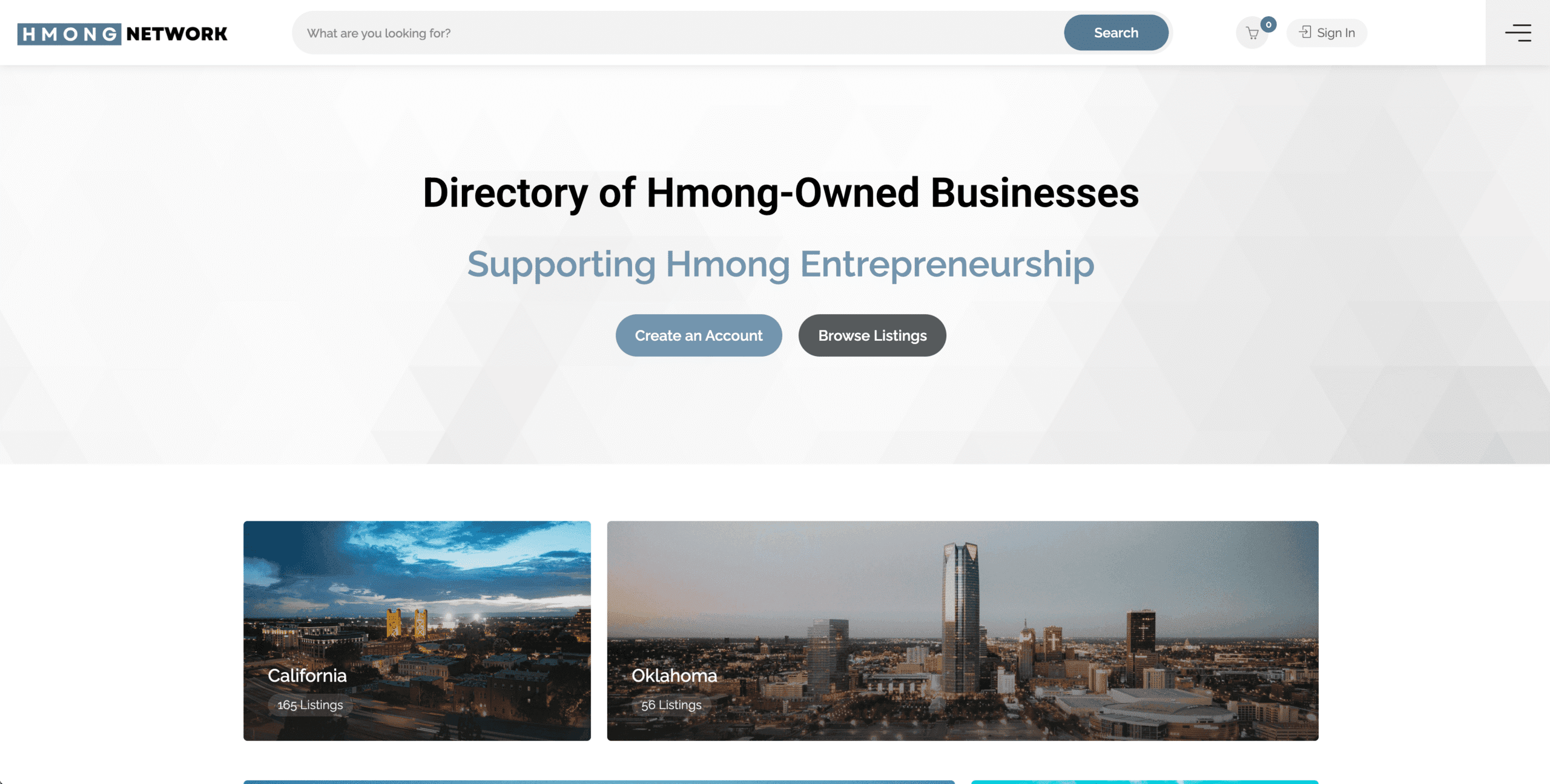
Hmong Network started as a WordPress directory and became a custom platform: a directory of 1,100+ Hmong-owned businesses, a multi-seller marketplace with payouts and shipping labels, offline-scanning event tickets, owner tools, AI-assistant visibility, and a full admin desk. This is the story of the rebuild and what it gives a community organization.
Introduction
Hmong Network started in 2023 as a WordPress directory: a place to find Hmong-owned businesses across the United States. In 2026 it became something much bigger. It is now a custom-built platform that works as a business directory, a marketplace where those businesses sell directly, an event ticketing system, a content and community hub, and an operations desk for the team that runs it, all on one codebase we built and maintain with the founders.
This is the story of that second chapter: why the WordPress site had run out of room, what we rebuilt, and what a community organization gets when its website stops being a brochure and starts being infrastructure. If you read the other Hmong business stories in our portfolio, Hmong Network is the platform many of those businesses are listed on.
The starting point
The original site did its job. It launched with a polished directory design, regional pages, a blog, and a marketplace, and it gave Hmong business owners a home online. We wrote up that first build as a WordPress directory case study, and everything in it was true: a strong launch, solid desktop performance, and a clear weak spot on mobile.
The trouble was what the founders wanted next. The mission had grown from list the businesses to send them real customers, prove it with numbers, and make it possible for any owner to sell online. That meant real checkout and seller payouts, shipping labels, returns, event tickets that scan at the gate, owner dashboards with honest analytics, and a way to be found by the AI assistants people now ask for recommendations. A stack of themes and plugins can imitate pieces of that. It cannot do all of it safely, quickly, and in one consistent experience. The site needed to be built, not assembled.
The rebuild
We moved Hmong Network off WordPress onto a custom application and went live on August 29, 2026. The cutover was the part most directory migrations get wrong, so it got the most care:
- More than 1,100 real listings came across with their details intact, and every old WordPress address redirects to its new home, so years of links, bookmarks, and search rankings carried over instead of breaking.
- About 2,600 pages are generated ahead of time, so category pages, state pages, and business profiles load instantly rather than being assembled on each visit.
- A clean, modern design built on the site's established blue identity, with a bilingual interface toggle so the site chrome can be read in Hmong as well as English.
The new site is faster and easier to run, and it stopped being the ceiling on what the organization could offer.
A directory built to be found, by people and by AI
A directory is only worth listing in if people find it. Hmong Network's goal is to be the first answer for Hmong-owned businesses, in classic search and in the AI assistants that are replacing it for local questions like "Hmong restaurants in St. Paul." So the site is built for both audiences:
- Programmatic landing pages for every category, every state, and every category-in-state combination, each opening with real background on the community and the trade rather than a bare list.
- Structured data on every listing so search engines understand exactly what a business is, where it is, and when it is open, with rating markup shown only when a business actually has reviews.
- Machine-readable versions of the whole site. Every public page has a Markdown twin for AI crawlers, the site publishes an
llms.txtguide, and it runs a public, read-only MCP endpoint so AI tools can query the directory directly and cite it accurately. - Owner-written articles published on each business's own listing, answering the questions customers really ask: menus, pricing, process, local knowledge.
- Bold Beginnings, a growing series of first-person interviews with Hmong business owners, in their own words.
Every business gets a real profile, and a way to prove it works
A listing on Hmong Network is a working storefront for the business, not a name and a phone number. Customers can call, get directions, visit the website, message the owner, read and leave reviews, and book appointments right from the profile. Owners claim their listing through a verification step, then manage it from their own dashboard: photos, hours, descriptions, FAQs, articles, services, and menus.
The part owners tell us they value most is the proof. Every visit and every call, direction, or booking tap is counted per listing, including listings nobody has claimed yet. The day an owner claims theirs, they see the leads that were already sent their way. For a small business that has never been able to measure what its web presence does, that is the first honest answer to "is this worth it?"
A marketplace where Hmong-owned businesses sell directly
The old site had a marketplace bolted on through plugins. The new one is built from the ground up around how a community marketplace has to work: customers check out once, even from several sellers, and every seller is paid out correctly without anyone reconciling spreadsheets.
- Storefronts and products for every vendor, with variants, add-ons, inventory, bulk upload, and digital downloads.
- Secure checkout with card payments, automatic sales-tax calculation, and inventory held for the buyer while they pay.
- Seller payouts and a clear ledger. Each seller sees what they earned, what was withheld, and what has been paid, calculated from the actual order record.
- Shipping labels inside the dashboard. A seller picks a package size, compares live carrier rates, buys the label, and prints it without leaving the site, and the cost lands in their ledger automatically.
- Returns and refunds handled as a first-class workflow with buyers and sellers on the same page, and an escalation path for disputes.
- Shopify sync so a seller who already runs a Shopify store can connect it and have products and fulfillment flow through instead of retyping their catalog.
Events and tickets that work at the gate
Hmong New Year celebrations are among the biggest gatherings in the community, so ticketing was a natural next step. We built presale ticketing first for the Oklahoma Hmong New Year, sold through the same checkout as everything else. Buyers get a QR ticket, one code per order and day, and the staff scanner is a phone that keeps working with no signal, which matters in a crowded hall where the Wi-Fi never does. Ticket sales can be grouped, limited to specific dates, and refunded cleanly, and there is a ticket guide that walks an organizer through the event-day steps. Nothing in it is specific to one event, so the next organizer can use it too.
Tools that help owners grow
Hmong Network does not stop at listing a business. It gives owners tools that normally cost a marketing agency:
- A free website audit that checks a business's own site for search and AI-answer readiness and produces a plain-language report.
- AI writing assistance for listing copy and articles, with a clear credit balance and a confirmation before anything is spent.
- Social posts planned and published for the network automatically, so the community's story keeps showing up in feeds.
- A Community Passport that rewards people for visiting Hmong-owned businesses and events, and an opt-in community digest that points customers to new businesses and events near them.
- Seller tips and guided solutions inside the dashboard, so owners learn what to do next without hunting for a tutorial.
Running it day to day
A platform like this is only as good as the team's ability to run it. The admin panel gives the Hmong Network staff one place for what used to be scattered across inboxes and plugin screens: listing and claim reviews, content moderation, orders and returns, payouts, support messages, events, email activity, the audit leads, social posts, and site health. Reports, charts, and alerts show what needs attention. Account safety, privacy requests, and data-retention rules are built in rather than bolted on, because a marketplace holding customer addresses and payments has to take them seriously.
What changed
| Before (WordPress) | Now (custom platform) |
|---|---|
| Directory with a plugin marketplace | Directory, marketplace, tickets, and community tools in one product |
| Basic listings | Claimable profiles with per-listing lead tracking, booking, and owner articles |
| Search-engine optimization only | Search plus AI-assistant visibility: Markdown pages, llms.txt, and a public MCP endpoint |
| Checkout through plugins | Multi-seller checkout, tax, payouts, shipping labels, and returns |
| Admin spread across plugins | One admin panel for the whole operation |
| Mobile performance flagged as a weak spot | Pages generated ahead of time and a mobile-first rebuild |
Why it matters
Hmong Network proves a point we care about: a community organization does not have to settle for a template. Because we built the platform around what the community actually does, such as New Year events, family-run shops, and owners who are great at their craft but short on time, every feature earns its place. The result is a site that sends customers to Hmong-owned businesses, shows those owners the proof, and gives them the tools to grow.
It also became the model for how we work with Hmong-owned businesses today. If you are one, or you serve a community that deserves something better than a plugin stack, see how our partnership with Hmong Network works or tell us what you are trying to build.
Where to see it
Hmong Network is live at hmong.network. Browse the directory, open a business profile, or list your own business for free.